


Food for Thought- Persimmons!

The persimmon is an orange-colored fruit native to China. Several thousands of years ago, it was introduced in Japan and since then, the persimmon has become Japan’s national fruit and one of the traditional foods of the Japanese New Year. The persimmon fruits first arrived in California in the mid 1800s, making it one of the earliest commercially grown fruits in the United States. Like the tomato, persimmons are not popularly considered to be berries, but in terms of botanical morphology the fruit is in fact a berry.
There are hundreds of varieties of persimmons, with only about 2 that are easily available commercially – the fuyu and the hachiya. They are generally divided into two groups: the astringent (bitter) and the non-astringent. The fuyu belongs to the non-astringent types because it is palatable both before and after fully ripening, where as the hachiya belongs to the astringent varieties, which are only edible after fully ripening.
Fuyu Persimmons
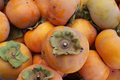
Hachiya Persimmons
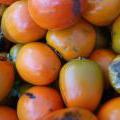
Even though in the past, the astringent hachiya persimmon variety was the most common persimmon, today the fuyu persimmon accounts for about 80% of the persimmon market, with the hachiya accounting for only about 20%.
Buying and Storage
Persimmons are best harvested in fall. You can buy them soft and ripe and eat right away or buy them hard for later use. They will ripen on their own at room temperature over a period of several days. They are generally speaking not a fast ripening fruit like strawberries or bananas. Hence an unripe bunch can last weeks. However, once ripe they do not keep well and thus should be eaten quickly.
Refrigeration is not necessary and may actually ruin the fruit.
Generally speaking it is best to eat persimmons when they are fully ripe and soft, which is when their sweet taste reaches its optimal peak. They are typically found in some stores in North America from late fall, through winter and into early spring. One can typically find them more easily in ethnic markets, where the demand for them is high.
Nutritional Benefits
Persimmons are a rich source of antioxidants, vitamin A, manganese and fiber, especially soluble fiber. They contain a fair amount of some of the B-complex vitamins, potassium and calcium. Generally speaking 1 fruit contains:
- Calories: 118
- Carbohydrates: 19 – 31g
- Omega-3 fatty acids: 6.7mg
- Omega-6 fatty acids: 65.5mg
- Protein: 0.6 - 1g
- Fiber: 4 – 6g
- Vitamin A: 2733-2642 IU
Preparation
Persimmons are best eaten raw. They are also commonly dried. To prepare, simply wash the fruit thoroughly and then there is a choice of how one wants to cut it. Cut in half, then cut halves up into quarters/slices or just eat the halves as is. There are no pits or seeds of any kind to make eating the whole fruit uncomfortable in any way. Generally peeling is not needed, unless one is not sure of the pesticide use on the fruit. Persimmons can also be used in smoothies and purees, in which case the peel should be removed as it is tougher than some peels. It is also a great addition to any fruit or even vegetable salad.
- Aparna Ramadurai
10/09/2013