


Food For Thought- Broccoli!

Broccoli belongs to a family of vegetables called cruciferous vegetables and its close relatives include brussel sprouts, cauliflower, and cabbage. Broccoli is high in sulforophane, a sulfur-containing compound present in cruciferous vegetables. Sulforophane has anti-cancer properties and may promote the elimination of potential carcinogens from the body. Studies suggest that a diet rich in cruciferous vegetables may reduce the risk of some cancers, especially stomach and lung cancers.
A cup of cooked broccoli offers as much vitamin C as an orange, and is very rich in beta-carotene. Broccoli contains vitamins B1, B2, B3, B6, iron, magnesium, potassium, and zinc too. It is also high in fiber and low in calories.
History of Broccoli in the United States
Broccoli has been around for more than 2,000 years but has only been commercially grown in the United States since the 1920s. Today, more than 90% of the broccoli harvested in the United States comes from California, although it is also grown in other parts of the country.
About 2 decades ago, researchers first suggested a possible link between diets high in cruciferous vegetables (a group of plants including cauliflower, cabbage, broccoli, and Brussels sprouts)) and a lower risk of cancer. However, it was not until the 1990s that certain chemicals found in broccoli were identified as possible cancer-preventing compounds.
Broccoli Varieties
There are three commonly grown types of broccoli.
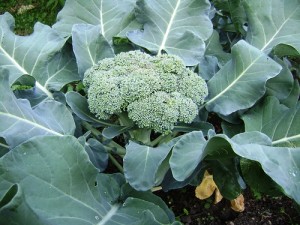
The most familiar is Calabrese broccoli, often referred to simply as “broccoli”, named after Calabria in Italy. It has large (10 to 20 cm) green heads and thick stalks. It is a cool season annual crop.
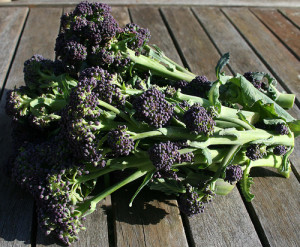
Sprouting broccoli has a larger number of heads with many thin stalks.
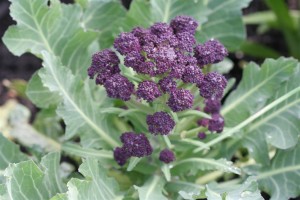
Purple cauliflower is a type of broccoli sold in southern Italy, Spain, and the United Kingdom. It has a head shaped like cauliflower, but consisting of tiny flower buds. It sometimes, but not always, has a purple cast to the tips of the flower buds.
Broccoli Season
Although readily available year-round, prime time for fresh broccoli is October through April in the Northern hemisphere. Broccoli is a cool-season crop that, like spinach, can be grown in the spring or fall. In fact, you may be able to get a continual harvest throughout both seasons if you time planting correctly.
Selection & Storage
When selecting broccoli, look for lively green leaves and firm, thin stalks. Thick stalks will be woody and are a sign of over maturity. The florets should be compact, firmly closed, and of a deep green color. Reject any heads that show any sign of yellowing or tiny yellow flowers as this is an indication of age.
Consume fresh broccoli as soon as you can as it will not keep long. To store, mist the heads, wrap loosely in damp paper towels, and refrigerate. Use within 2 to 3 days. Do not store broccoli in a sealed plastic bag. Raw broccoli requires air circulation. A perforated plastic bag is fine.
Nutrition Facts
1 cup chopped raw broccoli contains: 31 kcal, 6 gm carbohydrates, 2.4 gm fiber, 0.3 gm fat and 2.6 gm protein
Broccoli is a great source of vitamins K, A, and C, in addition to fiber, potassium, folate, and lutein.
Vitamin K – essential for the functioning of many proteins involved in blood clotting
Vitamin A – helps vision and is required for the immune system and production of red blood cells.
Vitamin C – builds collagen, which forms body tissue and bone, and helps cuts and wounds heal. Vitamin C is a powerful antioxidant and protects the body from damaging free radicals.
Fiber – diets high in fiber promote digestive health. A high fiber intake can also help lower cholesterol.
Potassium – a mineral and electrolyte that is essential for the function of nerves and heart contraction.
Folate – is necessary for the production and maintenance of new cells in the body.
Lutein - may slow progression of age-related macular degeneration and cataracts.
Health Benefits and best cooking methods:
Including broccoli in your diet regularly may reduce and prevent ailments like cancer, diabetes, heart disease, high blood pressure and it may help lower blood cholesterol.
Prevent Cancer: Broccoli is an excellent source of sulforaphane, a naturally occurring plant compound that has been shown to be protective against cancer. According to new research by the University of Illinois at Urbana-Champaign presented at the annual meeting of the American Institute for Cancer Research (AICR) in Bethesda last week, the best way to cook the vegetable is to steam it for three to four minutes. They say steaming it until it turns a bright green color can enhance its cancer-fighting compounds. The enzyme myrosinase in broccoli is needed for sulforaphane to form - so if the myrosinase is destroyed, sulforaphane cannot form. The researchers found boiling and microwaving broccoli, even for just one minute, destroys most of the myrosinase it contains. In contrast, they also discovered that steaming it for up to five minutes is the best way to retain the enzyme.
“As we’re learning, food processing isn’t just what happens to food before it reaches the grocery shelves,” AICR associate director of nutrition programs Alice Bender said in the news release. “This research highlights that what you do in your kitchen can make those fruits and vegetables on your plate even more cancer-protective.”
Prevent osteoarthritis - A British study revealed that broccoli contains sulfophane which may help fight osteoarthritis. sulforaphane can block cartilage-destroying enzymes by intercepting a molecule that causes inflammation.
Protect your skin against the effects of UV light - broccoli may help prevent skin cancer, not by eating it though, but by applying it directly to the skin. An article in the Proceedings of the National Academy of Sciences found that the damaging effects of UV radiation can be appreciably reduced with the topical application of a broccoli extract.
Reverse diabetes heart damage - Eating broccoli promotes the production of enzymes that help protect heart blood vessels and reduce the molecules that damage them.
Fun fact: Is a brocollette a kind of broccoli?
Although often misidentified as young broccoli, a broccolette or broccolini is a green vegetable similar to broccoli but with smaller florets and longer, thin stalks. It is a hybrid of broccoli and kai-lan, Chinese broccoli.
Eat more of these “little trees” to help provide you with a powerhouse of nutrients and to stay healthy!
-Aparna Ramadurai MS, RDN
11/12/13